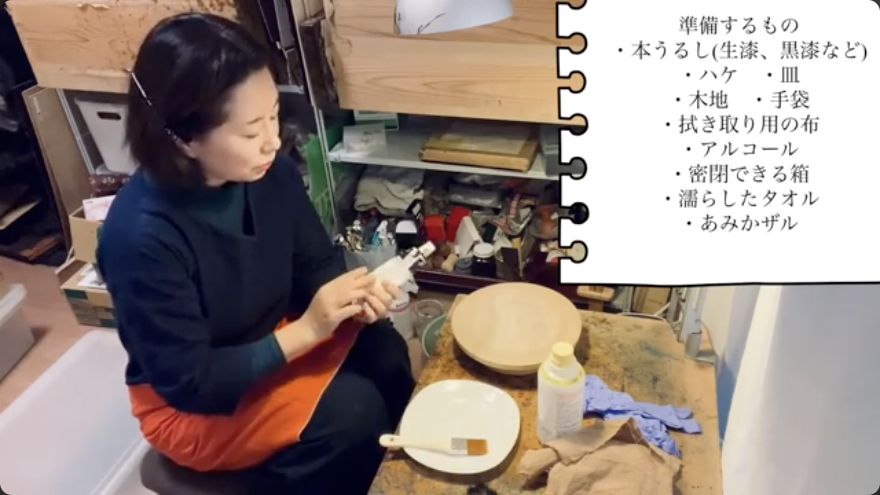
This video demonstrates a beginner-friendly method for applying a single coat of lacquer (fuki-urushi) to a wooden substrate. It is useful for hobbyists who want to try lacquer work without professional equipment, covering material preparation, application, curing, and cleanup.
A walkthrough written from 松江藩御抱え塗師12代目 小島ゆり’s video ↗.
The recording is the authoritative demonstration; this page is a working guide to it.
Raw urushi causes serious delayed skin reactions. Gloves are mandatory when handling wet lacquer. Do not touch the surface with bare hands until it is fully cured and dry, as sticky lacquer is hazardous.
Read Safety First before working with raw urushi.
Tools shown
hake— Lacquer brush, can be from a 100-yen shop
plate— Any flat surface to dispense lacquer
cloth or paper— Unused, for wiping off excess lacquer
airtight container— Plastic storage case or cardboard box for curing
mesh or strainer— To separate piece from wet towel
Materials
kuro-urushi— Black lacquer; the video mentions ki-urushi as standard but uses black for the demo
wet towel— Used to raise humidity in the curing box
disinfectant alcohol— For cleaning tools and surfaces
gloves— Mandatory for skin protection
Conditions
temperature — above 20°C
humidity — at least 50%, ideally around 80%
cure time — at least one night; 2–3 days to one week in winter
notes — Curing requires high humidity; direct contact with water source must be avoided.
The method
Section by section.
Each heading links back to the moment in the source video where it begins.
Gather lacquer, a hake, a plate, the wooden piece, a wiping cloth, gloves, alcohol, an airtight box, a wet towel, and a mesh screen. Lay newspaper on the work table to protect it. Ensure the hake is clean; if reusing a brush, wash off oil first.
When it is rightAll items are within reach, and the workspace is protected from spills.
When it goes wrongForgetting gloves or the mesh screen can lead to skin exposure or uneven curing.
Put on gloves. Dispense lacquer onto the plate. Load the hake generously with lacquer. Apply it to the wooden surface in a single pass or a few passes. Since the excess will be wiped off, neatness is not required. The goal is to saturate the surface.
When it is rightThe surface is fully covered with a wet layer of lacquer.
When it goes wrongApplying too little may result in patchy coverage after wiping.
Immediately after applying, use the unused cloth or paper to wipe off the excess lacquer from the surface. This step creates the fuki-urushi finish, leaving a thin, even layer rather than a thick coat. Do not scrub; simply wipe to remove the bulk of the material.
When it is rightA thin, uniform film of lacquer remains on the wood.
When it goes wrongWiping too aggressively may remove all lacquer, leaving bare spots.
Place the wet towel at the bottom of the airtight container. Put the mesh or strainer on top of the towel. Place the lacquered piece on the mesh so it does not touch the wet towel directly. Close the lid to trap humidity. The environment should be above 20°C and at least 50% humidity, ideally around 80%.
When it is rightThe piece is suspended above the moisture source in a sealed, humid space.
When it goes wrongDirect contact with the wet towel can cause the lacquer to cure too quickly or unevenly.
Allow the work to remain inside the humid box for a minimum of one night; under winter or cooler conditions, this period should be extended to two or three days, or potentially as long as a week. To verify curing, press a cotton swab against the surface. The piece is ready when the swab leaves no color behind and the texture feels dry. Conversely, if the surface feels sticky, it has not dried and is still hazardous to handle.
When it is rightThe surface is dry to the touch and does not transfer color to a cotton swab.
When it goes wrongHandling a sticky surface can cause skin irritation and damage the finish.
Wash the hake with cooking oil if you plan to reuse it, then remove the oil before the next use. For disposable brushes, discard them. Wipe the plate and any spilled lacquer from the table with a tissue dampened with disinfectant alcohol. Discard the newspaper if it is soiled.
When it is rightAll tools and surfaces are free of residual lacquer.
When it goes wrongLeaving oil on the brush will prevent the next coat of lacquer from curing.
Terminology in this video
拭き漆fuki-urushi
wipe-on wipe-back finish
黒漆kuro-urushi
black lacquer
木地kiji
the bare wooden substrate
刷毛hake
lacquer brush
Left open
What this video does not settle.
The exact type of cloth or paper recommended for wiping is not specified beyond 'unused'.
The specific brand or type of gloves is not mentioned.