Urushi fountain pens, and the work underneath the finish.
Fountain pens are where most people outside Japan meet urushi first — a Pilot Custom Urushi,
a Nakaya, a Namiki, a Danitrio — and the prices raise a question the marketing copy rarely
answers: what is actually being done to the barrel?
Weeks of labour spread across a dozen or more separately cured layers. This page names the
makers, explains what each of their finish names means, and points at both the written
sources and the people filming the work. Everything technical here is grounded in the
handbook chapters it points at, and those chapters cite their own sources in turn.
What the money buys
The documented sequence for a plain black polished barrel — before any decoration is added.
The documented sequence for a roiro-migaki pen barrel. Band heights are proportional to coat
counts, not to real thickness — the whole lacquer stack on a finished pen is a fraction of a
millimetre, which is exactly why a coat too thick will stop the cap closing. Chapter 31 →
Reading the finish names
Maker listings describe the surface in Japanese technique terms. These are the ones you will
meet on a pen.
These are CSS approximations, not photographs. Lacquer gets its character from depth — layers
you look into rather than at — and no flat colour reproduces that. Use them to attach a
name to a finish, then go and watch the sources.
The houses
Established makers you can buy from without commissioning anything. Ordered roughly by how
often people search for them.
Nakaya
The house most people mean when they say "urushi pen".
Origin
Japan
Position
High end
Kind
Established house
Founded by former Platinum engineers, Nakaya builds ebonite bodies and finishes them by hand, offering the same shape in a long list of lacquer treatments — kuro-roiro black, shu vermillion, and the tamenuri variants (midori, aka, kuro-tame) that shift as the clear coats clarify with age. Nakaya confirms every pen is finished by an urushi craftsman but does not publish steps or timings, which is normal for craft workshops and worth remembering when a listing implies more precision than the maker claims.
Pilot’s maki-e line, and the guild that decorates it.
Origin
Japan
Position
High end
Kind
Established house
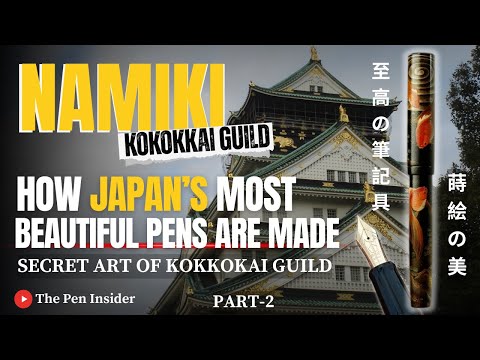
Namiki is Pilot’s decorated line, historically supplied by the Kokkokai — a guild of maki-e artisans assembled in the 1930s to work on pens specifically. The Yukari and Yukari Royale ranges are where the full decoration vocabulary appears: sprinkled gold laid flat (hira maki-e), polished back through clear coats (togidashi), built into relief (taka maki-e), engraved and gold-filled (chinkin), and inlaid with shell (raden). Prices track the decoration, not the pen.
The Custom Urushi and Custom 845 — the most-searched urushi pens there are.
Origin
Japan
Position
Mid range
Kind
Established house
The Custom 845 and the larger Custom Urushi are plain lacquered ebonite in black or vermillion, with no decoration — which makes them the clearest illustration of what the finish alone does. This is also the most-searched urushi pen in the data behind this site by a wide margin, and the usual first real urushi pen people buy. There is nothing beginner about the finish itself; it is simply undecorated.
Labels its finishes by technique — a useful vocabulary check.
Origin
Japan / United States
Position
High end
Kind
Established house
Danitrio is worth knowing even if you never buy one, because it names finishes by the technique rather than by a marketing colour: "Roiro-migaki Black", "Kama-nuri Red Roiro-migaki", "Midori Nashiji-nuri". Read against Chapter 20 and Chapter 28, those listings become a concrete glossary of what was actually done to the barrel — which is rare, and more informative than most maker copy.
The Izumo line, plus the cheapest way to hold real urushi.
Origin
Japan
Position
Mid range
Kind
Established house
The Izumo range carries lacquered bodies at a step below the commission houses. Platinum is also the unexpected entry point: independent finishers lacquer the plastic Preppy — a pen that costs a few dollars — and the result is a genuine urushi surface on a disposable body, which is the least expensive way to see what the finish does in person.
Wajima-nuri and taka maki-e at a lower entry point, sold direct.
Origin
Japan
Position
Entry point
Kind
Established house
Wancher works with Wajima artisans and publishes an unusual amount about the process on its own channel — which is why it is in this archive as a source, not only as a brand. Their Dream Pen line puts urushi and maki-e at a materially lower price than the commission houses; read their own videos for what is done by hand and where.
Smaller operations and individuals — where the process is usually documented far better than
the houses document theirs.
Tamenuri Studio
An independent finisher who documents the whole process publicly.
Origin
Europe
Position
Commission
Kind
Independent
Michal Kulka works on pens and — unusually — publishes the reasoning as well as the result: which grades he uses, how long he cures, which brushes failed, what a botched coat looks like. Much of this guide is grounded in that documentation. If you want to understand what the commission houses are not telling you, this is the closest available substitute for standing in the workshop.
People lacquering their own barrels, mistakes included.
Origin
Anywhere
Position
Entry point
Kind
Independent
A pen is a bad first project — cylindrical, tight-toleranced, and every threaded part has to be masked before every coat or it will not assemble. But people do it, and the honest amateur attempts are more instructive than the polished maker films, because you can see where the coat went wrong. Start on something flat, then come back to a barrel.
Because the finish is measured in weeks of labour and cure time, not in material cost. A documented roiro-migaki pen sequence runs at least nineteen steps — two raw seshime coats, five cycles of brushed black naka-nuri with 48-hour cures and charcoal flattening, two kuro-roiro coats, then a long alternating polishing phase — with one to five days of curing between each step in a box held at 25–28 °C and 65–80% humidity. Nakaya, Namiki/Pilot and Danitrio all sell pens finished this way by hand.
Translucent finishes do. Tamenuri layers a coloured or black under-layer beneath several coats of clear kijiro, and as the clear layers gradually become more transparent with age and handling, the colour beneath reads more strongly — the effect people describe as an urushi pen "opening up". Opaque black roiro finishes do not shift colour in the same way; they deepen in gloss with polishing and use.