A Seiko Presage with an urushi dial is, for a lot of people, the first time they own
anything lacquered — and the dial is doing exactly what a lacquered bowl or pen barrel
does, at a scale that makes every part of it harder.
This page explains what is happening under the crystal, and names the lacquer workshops
behind the dials — because on a watch, the interesting maker is usually not the one on the
face.
Why a dial is the hard version
The material behaves as Chapter 4 and Chapter 17 describe. The object is what changes.
It has to stay thin
The hands sweep a hair above the dial. A lacquer stack that would be unremarkable on a bowl fouls the seconds hand, so the coat count that gives a pen its depth is not available here — the depth has to come from fewer, better layers.
It is pierced, and the holes must stay crisp
A dial has a centre hole for the hands, often a date aperture, and feet on the back. Lacquer creeps. Every opening has to be masked and kept clean through a dozen operations, the same discipline a pen’s threads demand.
The blank is thin metal, not wood
Brass at a fraction of a millimetre, cured repeatedly in a humid box. It does not absorb the first coat the way wood does, and it will take a set if the stack pulls unevenly as it cures.
The gold has to be finer
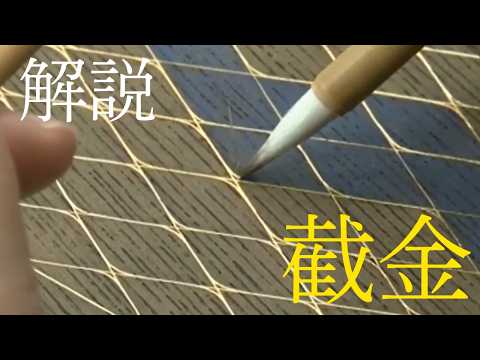
Sprinkled powder that reads as a rich texture on a writing box reads as a defect at 30 mm. Dial work sits at the fine end of the powder grades, and at the extreme it is kirikane — cut leaf a ten-thousandth of a millimetre thick.
What you are looking at
The finish vocabulary, shared with pens and boxes.
These are CSS approximations, not photographs. Lacquer gets its character from depth — layers
you look into rather than at — and no flat colour reproduces that. Use them to attach a
name to a finish, then go and watch the sources.
The technique, filmed
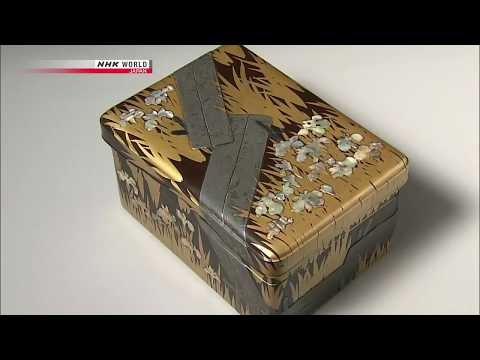
Not dial-making — the decoration itself, from the workshops that do it. This is the closest
you will get to watching a dial being made.
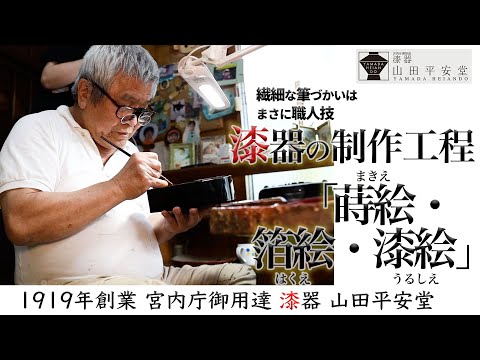
From the workshop that makes the Chopard dials, on how a design gets onto a lacquer surface.
Who makes them
From a watch you can buy in a shop to a numbered series of a few dozen.
Seiko Presage
The reason most people search for an urushi dial at all.
Origin
Japan
Position
Mid range
Kind
Established house
Presage is where a lacquered dial becomes something you can actually buy rather than commission, and Seiko has worked with named urushi artisans — Isshu Tamura among them — on the line. The dials are plain lacquer rather than heavily decorated: a deep black or vermillion field with the depth that many thin coats give and a printed or applied index on top. Seiko publishes little about coat counts or cure schedules, so treat any specific number you read elsewhere as unverified.
The maker-and-collaborator claims above are public record, not something this archive
verified from its sources. Confirm with the maker before repeating them.
Credor & Grand Seiko
Seiko’s high-end lines, where the dial becomes maki-e.
Origin
Japan
Position
High end
Kind
Established house
Above Presage, Seiko’s Credor and Grand Seiko lines have produced dials with sprinkled-gold decoration rather than a plain lacquer field — the same hira and togidashi maki-e vocabulary used on pens and boxes, executed at roughly 30 mm across. At that scale the gold powder grade matters more than anywhere else in the craft, because a coarse powder that reads as texture on a box reads as a blemish on a dial.
The maker-and-collaborator claims above are public record, not something this archive
verified from its sources. Confirm with the maker before repeating them.
Chopard L.U.C XP Urushi
Swiss movement, Japanese dial — decorated by Yamada Heiando.
Origin
Switzerland / Japan
Position
High end
Kind
Established house
Chopard’s L.U.C XP Urushi pairs a Swiss movement with a maki-e dial made in Japan by Yamada Heiando, a lacquer house that has supplied the Imperial Household. This is the one entry on this page you do not have to take on trust: Yamada Heiando published a two-part walkthrough of the collaboration from inside their own workshop, including trial dials that never shipped. Both parts are indexed here, in Japanese.
Maki-e dials at the commission end, in tiny series.
Origin
Switzerland / Japan
Position
Commission
Kind
Commission work
The Métiers d’Art maki-e dials are made in very small numbered series with Japanese lacquer artists — the Unryuan workshop of Kitamura Tatsuo is the name most associated with them. This is the top of the market and effectively commission work: the watch is a carrier for a lacquer panel, priced accordingly.
The maker-and-collaborator claims above are public record, not something this archive
verified from its sources. Confirm with the maker before repeating them.