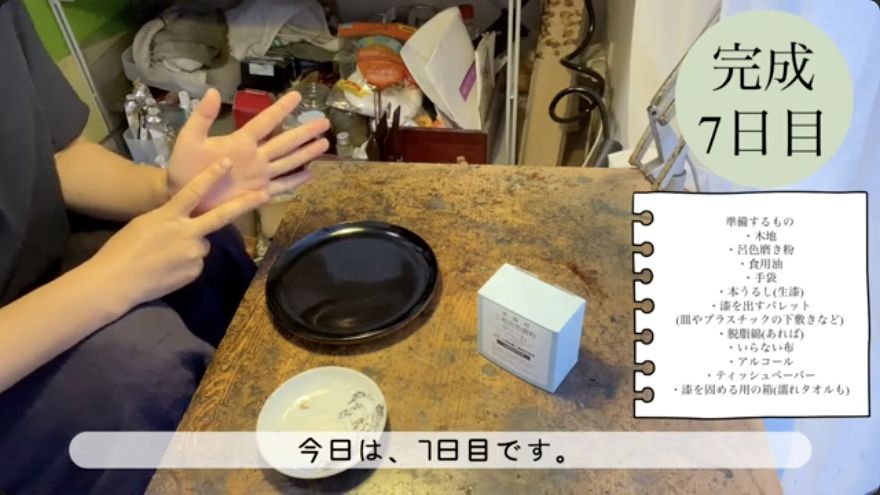
Finished! Day 7: Brush painting and mirror polishing "Polished to a shine" (Lacquer painting clas...
This video demonstrates the final stage of roiro (mirror) polishing for a lacquer piece on day 7 of the process. It details the use of oil and roiro powder to remove a previous layer of rubbed-in ki-urushi and achieve a high gloss. The tutorial is useful for lacquer artisans learning to judge surface hardness and execute the final polishing steps.
A walkthrough written from 松江藩御抱え塗師12代目 小島ゆり’s video ↗.
The recording is the authoritative demonstration; this page is a working guide to it.
Raw urushi causes serious delayed skin reactions. The video explicitly warns of urushi dermatitis when handling semi-dry lacquer and recommends wearing gloves, though bare hands are used in the demonstration for better gloss.
Read Safety First before working with raw urushi.
Tools shown
hands— used for polishing, with or without gloves
cloth— used to wrap cotton and wipe off lacquer
non-woven fabric— used to wipe off lacquer
Materials
ki-urushi— raw unrefined lacquer, previously rubbed in
cooking oil— applied thinly to the surface
roiro powder— polishing powder, turns brownish when used
water— added to ki-urushi if gloss is difficult to achieve
cotton— wrapped in cloth for rubbing in lacquer
tissue— used to apply oil and wipe off powder
Conditions
cure time — 10-15 minutes after wiping off lacquer
notes — When humidity and temperature are low, place the piece in a slightly more humid location to harden the lacquer.
The method
Section by section.
Each heading links back to the moment in the source video where it begins.
Following the prior application of ki-urushi, the surface exhibits a sheen. To enhance this gloss, perform an additional polishing step. First, spread a thin layer of cooking oil across the lacquered area. Next, place a small amount of roiro powder in your palm. Rub the surface so that the powder absorbs the oil; as it collects the oil, the powder will gradually develop a brownish hue.
When it is rightThe surface becomes shiny, and the powder on the hand turns brownish.
When it goes wrongIf the gloss does not appear, add one drop of water to the ki-urushi, mix it, and rub it in again before polishing.
Wearing gloves is recommended to prevent urushi dermatitis, even though hand polishing yields a higher gloss. Apply the powder to the fleshy area of the hand and rub the surface using the whole palm. The polish is considered sufficiently complete when the light bulb from the lighting reflects off the surface, and when the object achieves a mirror-like reflection, the process is nearly finished.
When it is rightThe surface reflects light like a mirror, indicating the polishing is nearly complete.
When it goes wrongIf the gloss is difficult to achieve, use the polishing method with oil and roiro powder when the lacquer is semi-dry.
For beginners, achieving a high gloss can be challenging. To address this, incorporate water into the urushi during the rubbing process. Specifically, add a single drop of water to the ki-urushi, ensuring it is mixed in. Subsequently, rub the water-mixed lacquer into the surface. To do this, wrap cotton in a cloth, apply the mixture, and work it in using circular motions. Ensure the entire area is covered by this rubbing action.
When it is rightThe lacquer is evenly rubbed in over the entire area.
When it goes wrongIf the gloss still does not appear, wait for the lacquer to harden before attempting to polish again.
Remove the lacquer using a cloth or non-woven fabric, then allow the piece to rest for 10 to 15 minutes. Should the ambient humidity and temperature be low, relocate the item to a spot with slightly higher humidity to induce a minor hardening of the lacquer. In this state, if the lacquer has not yet dried, the surface will remain clear and free of white cloudiness when exposed to breath. However, as the lacquer continues to set, the exhaled breath will progressively become apparent on the surface; observing this whitening effect upon blowing confirms that the lacquer is in the process of hardening.
When it is rightThe breath blown on the surface turns white, indicating the lacquer is setting.
When it goes wrongIf the breath does not turn white, the lacquer is not yet hard enough for polishing. Wait longer or adjust humidity.
As the blowing process has rendered the surface quite white, proceed to polishing. Apply a thin layer of oil to the surface using a tissue. Next, employ roiro powder to absorb and lift away the oil. Because the material is semi-dry, there is a risk of urushi dermatitis; therefore, wearing gloves is advisable. Nevertheless, working with bare hands facilitates achieving a higher gloss. Coat your fingers with powder and polish the entire area, blending the powder into the oil. The powder will take on a brownish hue.
When it is rightThe oil is removed by the powder, and the luster appears on the surface.
When it goes wrongIf the oil is not fully removed, the gloss will not appear. Continue polishing until the powder is brownish and the surface is shiny.
Remove the residual powder using a tissue. The process is complete when a sheen develops on the surface. As you gain experience through producing numerous works, this sheen tends to become more refined. For beginners, however, achieving a high-quality sheen can be challenging. Should this occur, incorporate water into the urushi as you rub it in and continue the polishing.
When it is rightThe surface has a clean, mirror-like gloss, and all powder is wiped off.
When it goes wrongIf the gloss is not clean, repeat the process of adding water to the lacquer and polishing again.
Terminology in this video
呂色roiro
polishing to a mirror surface
生漆ki-urushi
raw unrefined lacquer
摺り漆suri-urushi
rubbed-in lacquer
拭き漆fuki-urushi
wipe-on wipe-back finish
Left open
What this video does not settle.
The exact type of cooking oil used is not specified.
The specific brand or grade of roiro powder is not mentioned.
The exact humidity and temperature levels for the curing cabinet are not provided.