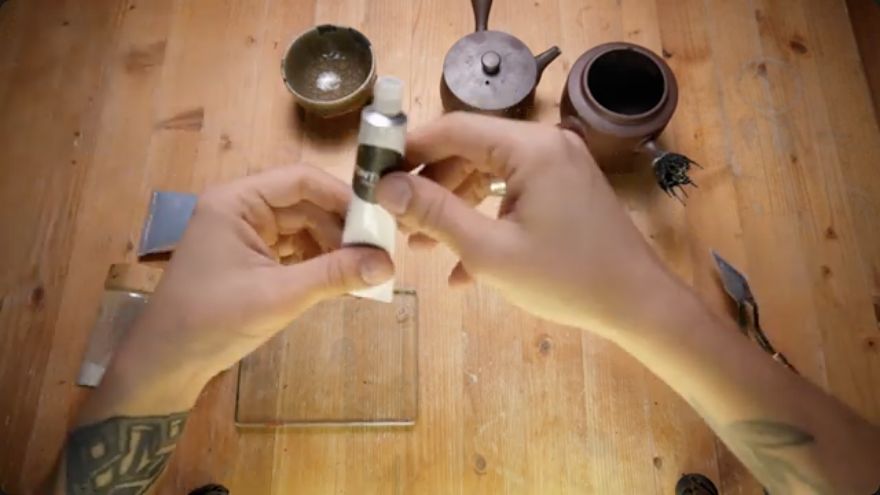
Кинцуги как сделать, видео уроки. Как наносить черный лак уруси
This video demonstrates the application of black lacquer to seal and level repaired ceramic seams in a kintsugi context. It is useful for practitioners learning to apply lacquer to porous substrates, specifically focusing on brush selection, the order of application (inside before outside), and the use of wire armature for structural repairs.
A walkthrough written from Kintsugi by Dmitry Bykov’s video ↗.
The recording is the authoritative demonstration; this page is a working guide to it.
Raw urushi causes serious delayed skin reactions. The video shows handling of lacquer without visible protective gear, which warrants caution.
Read Safety First before working with raw urushi.
Tools shown
flat synthetic brush— Recommended for sealing surfaces; described as elastic with high bristle count
thin brush— Used for detailing lines and finishing edges
tripods— Small stands used to hold ceramics during work
Materials
black lacquer— Used for sealing seams; can be thinned with turpentine or kerosene if too thick
red lacquer— Mentioned as an alternative; described as thicker than black
wire— Used to create a mesh armature for building up handle volume
ceramic powder— Mentioned for filling gaps, though application is not shown
Conditions
notes — The video mentions setting pieces aside to dry but does not specify duration or environmental conditions.
The method
Section by section.
Each heading links back to the moment in the source video where it begins.
The maker selects black lacquer for sealing seams, noting that red lacquer is an alternative but is thicker. If the lacquer is too viscous, it can be thinned with turpentine or kerosene. The goal is to create a waterproof seal and level the surface, addressing cracks and pores left by previous repairs.
When it is rightLacquer has a workable consistency that flows into pores without being overly runny.
When it goes wrongIf the lacquer is too thick, it may not penetrate the seam properly; thinning with solvent resolves this.
For sealing a surface area rather than a line, a flat synthetic brush is preferred due to its elasticity and bristle density. The maker applies the main body of lacquer with the larger brush and then uses a thinner brush to finish the edges. If lacquer goes beyond the seam edges, it is not critical on ceramics as it can be cleaned or polished off later.
When it is rightThe seam is fully covered and sealed, with excess lacquer manageable on the surrounding surface.
When it goes wrongExcess lacquer on the surface can be removed or polished off, so over-application is a minor issue.
The maker works from the inside of the teapot first, then moves to the outside. This order prevents dirtying the interior if the exterior is handled later. A thin brush is used to draw a line along the internal seam. The spout and external seams are then coated. The maker notes that the black lacquer looks aesthetically pleasing on the ceramic surface.
When it is rightThe internal seam is sealed first, followed by the external seams, ensuring no cross-contamination.
When it goes wrongWorking outside-in risks dirtying the interior; the inside-out order avoids this.
The primary goal is to level the lacquer so it is perfectly smooth. After the first layer dries, the procedure is repeated. Once the internal seam is sealed, the piece can be washed to remove old dust. The teapot is set aside to dry in a stable position.
When it is rightThe lacquer surface is smooth and even, ready for a second coat after drying.
When it goes wrongIf the surface is not smooth, additional coats are needed after drying to build up the level.
For a teapot handle, the maker creates a mesh using wire to build up volume. The wire is glued and knotted at the base to follow the geometry of the handle. This armature provides a structure for adding ceramic powder to fill gaps. The maker notes that the wire must be positioned correctly to maintain the handle's shape.
When it is rightThe wire mesh follows the handle's geometry, providing a stable base for filling.
When it goes wrongIf the wire is misaligned, it can be adjusted before adding the ceramic powder.
For a small teapot, the maker applies lacquer directly over internal cracks without opening the seam, as access is limited. The lacquer absorbs well into the cracks and sits securely without peeling. The external seams and rings along the circumference are also sealed with black lacquer.
When it is rightThe lacquer penetrates the cracks and adheres well, sealing them without the need for physical access.
When it goes wrongIf the lacquer does not adhere, it may peel; however, the maker notes it sits well in this case.
Terminology in this video
金継ぎkintsugi
lacquer repair finished in gold
黒漆kuro-urushi
black lacquer
朱漆shu-urushi
vermilion lacquer
Left open
What this video does not settle.
The specific drying time for the lacquer is not mentioned.
The exact ratio of solvent to lacquer for thinning is not provided.
The type of ceramic powder used for filling is not specified.