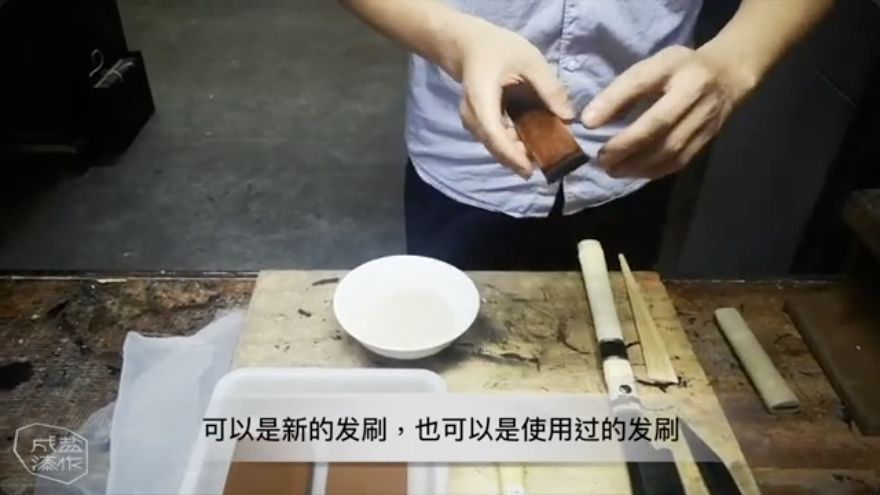
This video demonstrates the first three of eight steps for preparing a hair-bristle lacquer brush (hake) for use: cutting the tip, flattening the cross-section, and removing the wooden core sliver. It is useful for lacquer artists who need to prepare or re-sharpen their own brushes for applying middle or final coats.
A walkthrough written from 成盐漆作 Lacquer ChengYan’s video ↗.
The recording is the authoritative demonstration; this page is a working guide to it.
Place the brush at the table edge and press down the tail. Use a chisel knife to cut vertically at the root of the bristles. Switch to a smaller knife to correct the cut for evenness. Apply force horizontally (left-to-right or right-to-left) depending on habit. Check the alignment frequently while correcting.
When it is rightThe tip is cut straight and even across the width of the brush.
When it goes wrongUneven cut leads to uneven lacquer application; re-cut and re-grind if necessary.
Place the brush vertically on 600-grit sandpaper laid over a white porcelain plate. Rotate the sandpaper while keeping the brush still to grind the cross-section. Ensure even pressure to avoid angling the cut. After coarse grinding, switch to a 1000-grit whetstone. Hold the narrow end with both hands and grind back and forth to ensure flatness. Flatten the whetstone first if it is used.
When it is rightThe cross-section is flat and even, allowing uniform lacquer application.
When it goes wrongAngled cut from uneven pressure; cannot be corrected later, leading to uneven application.
First, establish a guideline 1cm below the top edge with an okote or plane. Next, create a small notch by sawing along this mark; apply firm downward pressure with the free hand while making 2-3 passes to achieve a depth of roughly 1mm. Following this, extract the resulting wood sliver using a blade or plane, taking care to keep the hand clear of the cutting edge. Finally, secure the tail against a stopper and support the brush from underneath, leaving the slivers on the narrow end untouched at this stage.
When it is rightThe sliver is removed cleanly without damaging the bristles.
When it goes wrongDamaging bristles or injuring hand; ensure proper hand placement and careful cutting.
Terminology in this video
刷毛hake
lacquer brush
中塗naka-nuri
middle coats
上塗uwa-nuri
final coat
Left open
What this video does not settle.
The exact type of hair used in the brush is not specified.
The specific technique for flattening the whetstone is mentioned but not demonstrated in detail.