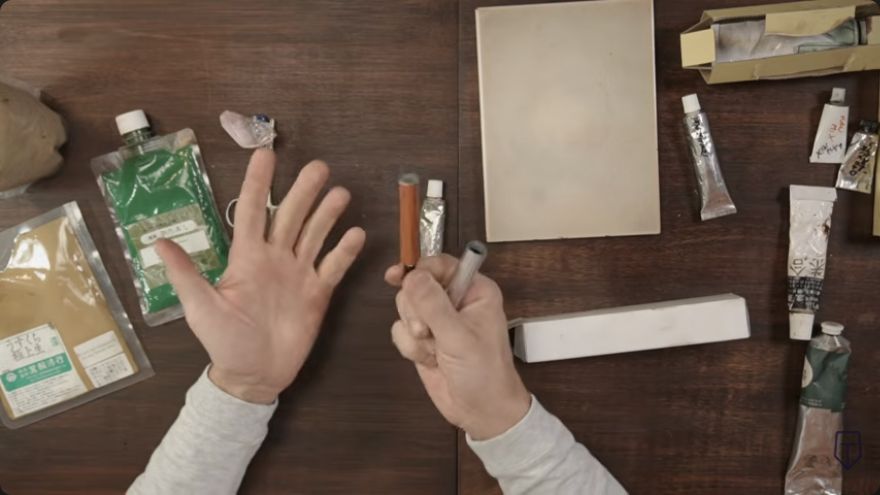
How to Store Urushi Properly (And Stop Wasting Expensive Lacquer)
This video provides a practical guide for lacquer artists on how to purchase, store, and maintain urushi to prevent spoilage and waste. It is useful for hobbyists and professionals who work with small quantities of various lacquer types and need to preserve their materials over time.
A walkthrough written from Tamenuri Studio’s video ↗.
The recording is the authoritative demonstration; this page is a working guide to it.
Avoid all skin contact with uncured urushi and with contaminated tubes, caps, film, clips, pliers, and brushes; exposure can cause serious delayed contact dermatitis. Use dedicated material storage rather than a refrigerator shared with food. Filling, folding, kneading, wrapping, and opening containers can leak or splatter, so keep them contained and stop if a package deforms.
Read Safety First before working with raw urushi.
Tools shown
adjustable-opening pliers— The maker uses the smallest Knipex model and says he thinks this style is generally called Cobra pliers
clips or pliers— Shown securing lacquer wrapped in barrier film
Materials
urushi— Various types including raw lacquer, colored lacquers, and fuki-urushi; stored in tubes, pouches, or barrier film
Saran Gold barrier film— The maker's named wrap for excluding oxygen; he cautions that ordinary food wrap is not equivalent and says he does not know its exact composition
aluminum tubes— Empty transfer tubes shown in 7 ml, 10 ml, 15 ml, and 30 ml sizes
Conditions
temperature — 8-10°C for refrigerator storage; 15-18°C for secondary storage
humidity — Controlled in the refrigerator
notes — These are the maker's storage settings. He reports contamination and odor in some large unheated raw-lacquer pouches; one special fuki-urushi product shown separates quickly.
The method
Section by section.
Each heading links back to the moment in the source video where it begins.
Estimate quantities from the scale of the work and the range of techniques planned. The maker explains that small objects using varied techniques call for several lacquer types in small quantities; his recommendation is to match purchases to expected use rather than assume one large container is economical.
When it is rightA clear understanding of which lacquer types and volumes are needed for upcoming projects
When it goes wrongBuying substantially more than the expected work will use, as happened in the maker's early purchases
The maker keeps lacquer in what he calls a special regulated refrigerator set to 8-10 °C and uses another storage area at 15-18 °C. These are his own settings, not universal targets. He reports that large pouches of unheated raw lacquer can become contaminated and develop an abnormal smell after roughly three months; he does not identify room temperature alone as the cause.
When it is rightEach container is stored in a dedicated material area with its condition and age known.
When it goes wrongA pouch that develops an abnormal smell may have become contaminated and needs separate evaluation.
Purchase tube sizes that match likely use. The maker first bought three or four 50 ml tubes—about 200 ml in total—and later shifted mostly to 50-100 ml purchases. Empty 15 ml and 30 ml tubes are discussed separately for transferring smaller amounts. Tube size reduces unused volume; it does not prevent a cap from sticking or breaking.
When it is rightLacquer stored in appropriately sized tubes that can be fully used before spoilage
When it goes wrongLarge tubes with broken or stuck caps that trap and waste remaining lacquer
For larger amounts of raw lacquer used in ground work, mugi-urushi, or repair, the maker buys half-liter or liter pouches. He also shows one special fuki-urushi product that separates quickly and explains that a pouch can be kneaded to recombine it. A separated tube can instead be squeezed out, mixed, and transferred; it is not impossible to recover.
When it is rightLacquer that can be mixed and recombined in the pouch before application
When it goes wrongA separated product must be recombined by a method suited to its container before use.
Use empty aluminum tubes in the shown 7 ml, 10 ml, 15 ml, or 30 ml sizes. Fill from the open back, push out the air as the maker demonstrates, flatten the end, and fold it several times. The source presents this as a convenient container for everyday quantities and custom mixes, without claiming a laboratory-grade airtight seal.
When it is rightThe tube contains the intended quantity, has excess air pressed out, and has a securely folded end.
When it goes wrongThe source gives no diagnosis or recovery procedure for an insecure fold.
For a small quantity needed over the next two or three weeks, the maker wraps it in a product he calls Saran Gold and secures the packet with clips or pliers. He says ordinary food wrap allowed lacquer to cure and stresses checking for the correct barrier-film type; he does not know its composition. He separately shows using the film around brushes to limit oxygen exposure.
When it is rightThe lacquer packet is closed in the maker's specified barrier film.
When it goes wrongOrdinary wrap may allow the lacquer to cure during storage, according to the maker's comparison.
The maker uses the smallest Knipex adjustable-opening pliers and says he thinks this style is generally called Cobra pliers. Set the jaw opening so the cap can be gripped without crushing it. He demonstrates this tool on his lacquer tubes but does not claim that one size fits every container.
When it is rightThe cap is gripped with the jaw opening limited rather than crushed by unrestricted pressure.
When it goes wrongThe video does not provide a recovery procedure for a deformed or leaking tube.
Terminology in this video
漆urushi
natural lacquer
麦漆mugi-urushi
lacquer and wheat-flour adhesive
下地shitaji
the ground layers beneath the coats
金継ぎkintsugi
lacquer-based repair; gold is one possible decorative finish
拭き漆fuki-urushi
wipe-on wipe-back finish
Left open
What this video does not settle.
The exact composition of the Saran Gold barrier film and the maker's specific oxygen-excluding claim
Whether the 8-10°C refrigerator setting is optimal for all lacquer types or only raw lacquer
The specific signs of lacquer spoilage beyond odor that should prompt disposal