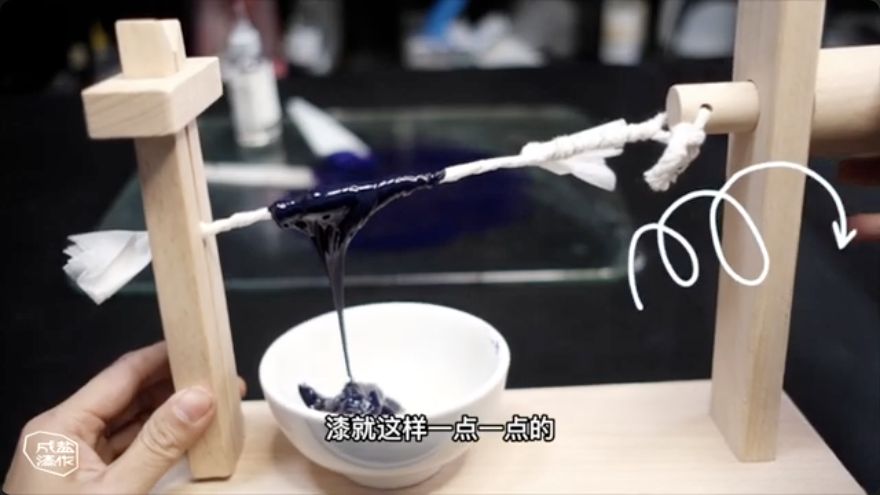
This video demonstrates the filtration of raw lacquer using a Japanese-style screw-press filter stand. It is useful for lacquer artists who need to remove impurities and dry skin from stored lacquer before applying final coats or decoration. The process covers tool assembly, surface preparation, the pressing mechanism, and proper storage of the filtered product.
A walkthrough written from 成盐漆作 Lacquer ChengYan’s video ↗.
The recording is the authoritative demonstration; this page is a working guide to it.
Raw urushi causes serious delayed skin reactions. Ensure proper ventilation and avoid skin contact with the lacquer and turpentine.
Read Safety First before working with raw urushi.
Tools shown
lacquer filter stand— 1:1 replica of Japanese design, includes base, clamp, and knob
glass plate— for mixing lacquer and turpentine
spatula (hera)— for scraping excess lacquer
small bowl— for collecting filtered lacquer
tissue paper— for wiping oil and cleaning
Materials
purple lacquer— tube-packaged, diluted with turpentine
Japanese filter paper— lint-free, specifically for lacquer
turpentine— used for cleaning and dilution
mint oil— two drops, used to coat the collection bowl
cling film— plastic wrap, preferred over other types to slow drying
Conditions
notes — Wait for dust to settle before filtering. Use cling film to slow drying.
The method
Section by section.
Each heading links back to the moment in the source video where it begins.
The stand consists of a base, a clamp end for the filter paper, and a knob end. Pass the sieve through the designated hole, insert the hemp rope, and tie a knot. One end secures the filter paper, while the other is tied to the rope for tensioning. Ensure the hemp rope is properly knotted to the stand before use.
When it is rightThe stand is stable, and the rope is securely tied to the knob mechanism.
When it goes wrongIf the rope slips, the tension will be lost, and the lacquer will not be pressed effectively. Re-tie the knot securely.
Clean the area thoroughly to remove dust. Wait for floating dust to settle before proceeding. Wipe the glass plate and the spatula clean using turpentine. This ensures no lint or fibers contaminate the lacquer during the mixing and filtering process.
When it is rightThe glass plate and spatula are free of dust and lint.
When it goes wrongIf dust is present, it will be incorporated into the lacquer, defeating the purpose of filtration. Re-clean the surfaces.
Squeeze the purple lacquer onto the clean glass plate. Add a small amount of turpentine to dilute it slightly. Mix well to ensure a uniform consistency. This dilution helps the lacquer flow through the filter paper more easily.
When it is rightThe lacquer is smooth and uniform in color and consistency.
When it goes wrongIf the lacquer is too thick, it may clog the filter paper. Add more turpentine if necessary.
Select a small, clean bowl and place two drops of mint oil at the base. With clean tissue paper, spread the oil uniformly across the bottom and sides. This layer stops the lacquer from adhering to the bowl, facilitating subsequent cleaning.
When it is rightThe bowl is evenly coated with a thin layer of mint oil.
When it goes wrongIf the oil is not evenly distributed, the lacquer may stick to the bowl. Re-apply the oil and wipe evenly.
Position the lacquer filter paper inside the bowl, then deposit the blended urushi into its center. Twist the material to enclose the liquid, forming a bundle similar to a wrapped confection. Slide one terminus of this bundle into the gap formed by the pair of wooden strips located on the stand's left. Finally, secure the upper section of that left-hand side using the square wooden block, ensuring the filter paper remains firmly in place and does not dislodge.
When it is rightThe filter paper is securely held in place, and the lacquer is contained within the paper.
When it goes wrongIf the filter paper slips out, the lacquer will spill. Re-secure the paper with the wooden block.
Tie the right end of the filter paper to the hemp rope. Twist the wooden block on the right side of the stand to apply tension. The lacquer will be squeezed out little by little from the filter paper. Continue twisting until the lacquer is fully extracted.
When it is rightThe lacquer is cleanly extracted from the filter paper and collected in the bowl.
When it goes wrongIf the lacquer is not fully extracted, it may remain in the filter paper. Continue twisting until no more lacquer is visible.
Use a clean spatula to scrape off any excess lacquer from the surface of the filter paper. Open the filter paper to inspect for impurities. Wipe the rim of the bowl with tissue paper to remove any stuck lacquer. Cover the bowl with cling film, folding the edges inward. Attach a label with the date of filtering.
When it is rightThe filtered lacquer is clean, and the bowl is properly sealed and labeled.
When it goes wrongIf the bowl is not sealed, the lacquer may dry out. Ensure the cling film is tightly folded over the rim.
Terminology in this video
箆hera
spatula used for scraping lacquer
拭き漆fuki-urushi
wipe-on wipe-back finish, mentioned as a use case for filtered lacquer
Left open
What this video does not settle.
The exact amount of turpentine added to the lacquer is not specified.
The specific type of mint oil used is not identified.