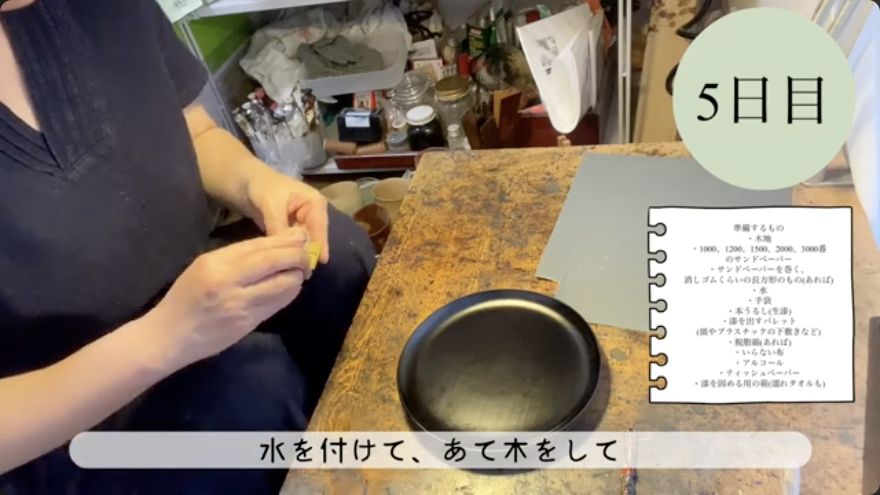
This video demonstrates the final stages of finishing a lacquered object: abrading the dried surface to flatness and polishing it to a mirror shine. It is useful for beginners learning the sequence of grits and the transition from sanding to cream polishing and suri-urushi.
A walkthrough written from 松江藩御抱え塗師12代目 小島ゆり’s video ↗.
The recording is the authoritative demonstration; this page is a working guide to it.
Raw urushi (ki-urushi) causes serious delayed skin reactions. Handle with care and avoid prolonged skin contact.
Read Safety First before working with raw urushi.
Tools shown
flat wood block— for wrapping sandpaper
soft cloth— T-shirt material for polishing
scrap cloth or cotton wool— for applying ki-urushi
Materials
sandpaper— 1000, 1200, 1500, 2000, 3000 grit
Kikumo— polishing cream
ki-urushi— raw unrefined lacquer for suri-urushi
alcohol— for removing oil from polishing cream
dish soap— alternative for removing oil
Conditions
notes — The work is hardened in a humid place after suri-urushi.
The method
Section by section.
Each heading links back to the moment in the source video where it begins.
One video is one workshop's account, not a complete method. 2 of 4 steps here are not fully settled by
this source — it leaves out what a correct result looks like, or how the step
fails. Those are marked in place below.
Wrap 1000-grit sandpaper around a small, flat piece of wood. Abrade the surface with water, moving straight back and forth. Rotate the work 90 degrees and repeat. The goal is to remove all gloss and brush marks, leaving a matte, slightly gray surface. This step removes bumps and dents; finer grits lack the cutting power to do so effectively. Be careful not to abrade the edges too much, as the lacquer coat is only about 0.1mm thick and the wood (kiji) can show through.
When it is rightThe surface is matte, flat, and free of brush marks or gloss.
When it goes wrongAbrading too much exposes the wood (kiji). Repair by applying lacquer with a brush and re-abrading.
Move to 1200-grit sandpaper to remove the marks left by the 1000-grit. Use a circular motion and slide the sandpaper rather than pressing hard. Continue with 1500, 2000, and 3000 grit, each time removing the marks of the previous grit. At each stage, the surface should feel smooth to the fingertips. If black ripple-like patterns appear, this is due to the multiple layers of kuro-urushi being abraded; it is normal and does not require immediate correction.
When it is rightThe surface is flat and free of scratches from the previous grit.
When it goes wrongApplying too much pressure can expose the wood. Slide gently instead.
Apply Kikumo polishing cream to a soft cloth like a T-shirt. Polish the surface in a circular motion, applying pressure to remove any remaining abrasion marks. Continue polishing while wiping off the cream. The cloth will turn black as it picks up residue. Use the fleshy part of the hand to polish. Repeat the process two more times to build up the gloss.
When it is rightA glossy surface is gradually appearing.
Not settled by this video The source does not show what going wrong looks like here.
To enhance the gloss prior to final polishing, apply suri-urushi. Begin by eliminating oil from the polishing cream, either by wiping the area with alcohol or washing it using dish soap. Next, dampen a piece of scrap cloth or cotton wool with a small quantity of ki-urushi. Work this lacquer into the coated surface using circular strokes to cover the entire area without omission. Once applied, remove the surplus lacquer with the scrap cloth, then allow the surface to harden in a humid environment.
When it is rightThe surface is ready for final hardening in a humid environment.
Not settled by this video The source does not show what going wrong looks like here.
Terminology in this video
木地kiji
the bare wooden substrate
黒漆kuro-urushi
black lacquer
生漆ki-urushi
raw unrefined lacquer
摺り漆suri-urushi
rubbed-in lacquer
Left open
What this video does not settle.
The exact duration for each abrasion step is not specified, only that it takes longer than applying lacquer.
The specific humidity and temperature for the furo are not mentioned.