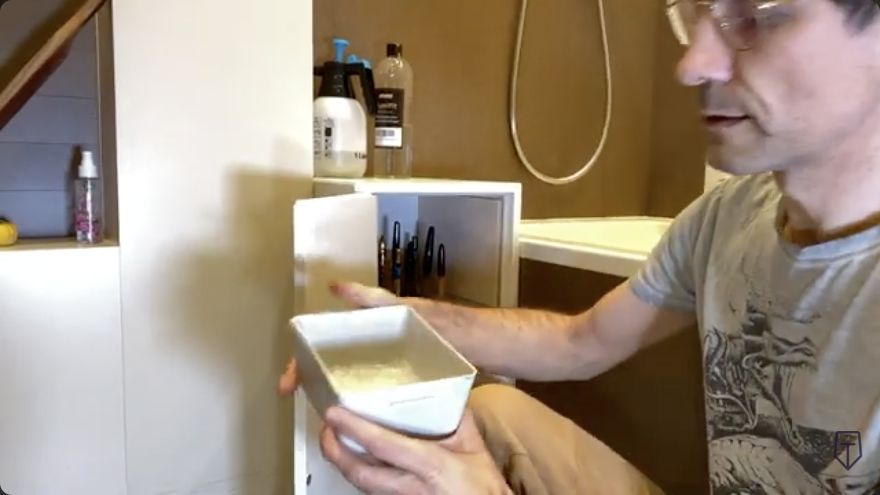
This video tours and explains the maker's already-built home urushi-furo, based on an IKEA cabinet. It is useful as a case study in one practitioner's humidity setup, not as a complete construction plan.
A walkthrough written from Tamenuri Studio’s video ↗.
The recording is the authoritative demonstration; this page is a working guide to it.
Editorial safety guidance: avoid all skin contact with uncured urushi and contaminated tools; use suitable gloves and contained cleanup. Follow the humidor-product label for handling and spraying because this video does not establish aerosol safety, efficacy, or compatibility.
Read Safety First before working with raw urushi.
Tools shown
Spray bottle— Gardening atomizer used to spray silver-ion water
Brushes— Stored in wooden racks inside the cabinet
Materials
IKEA cabinet— White, used as the base structure
Humidor gel— Bought from a cigar shop, used to regulate humidity
Silver-ion water— Bought from a cigar shop, used for spraying to boost humidity
speech-described wooden shelves— The maker says he built shelves from small wood pieces; sampled visuals confirm wooden brush racks but do not show their construction
Conditions
temperature — maker's bathroom is slightly below his stated 23-25°C range; exact value not given
humidity — maker states 70-90% RH, reports about 75% normally and about 85% temporarily
notes — The narration explains humidity-dependent urushi polymerization. A later cure-time passage is too garbled for confident publication.
The method
Section by section.
Each heading links back to the moment in the source video where it begins.
One video is one workshop's account, not a complete method. 4 of 4 steps here are not fully settled by
this source — it leaves out what a correct result looks like, or how the step
fails. Those are marked in place below.
The video shows a white IKEA cabinet used as the maker's furo. He says it is partly wood, describes shelves made from small wood pieces, and says he sealed the doors. The visual samples confirm the cabinet and wooden brush racks, but do not show construction or verify the door seal. Separately, he says a furo should use mold-resistant wood and later describes a larger, fully wooden future version.
When it is rightAn attributed record of this maker's existing prototype and its stated features.
Not settled by this video The source does not show what going wrong looks like here.
The maker uses humidor gel purchased from a cigar shop and says a small dry quantity became much more gel. The visual track shows clear viscous gel being poured from a tray into a white container; it does not show gel distributed through the cabinet.
When it is rightThe gel is contained in the white vessel shown in the visual track.
Not settled by this video The source does not show what going wrong looks like here.
The maker states a working range of 70-90% RH at 23-25 °C and says his usual result is about 75% RH. He also says the bathroom is slightly cooler than that temperature range, without giving an exact value. No hygrometer or monitoring action is visible in the sampled visual track, so these values remain attributed to his narration.
When it is rightThe record distinguishes the maker's stated range, his reported 75% result, and the unknown actual temperature.
Not settled by this video The source does not show what going wrong looks like here.
The maker says he sprays a cigar-shop silver-ion water product with a gardening atomizer when he wants a temporary humidity increase. He reports reaching about 85% RH for several hours and says he expects the product to control mold and microbes. The visual track shows bottles in the background but does not show spraying or verify those efficacy claims.
When it is rightThe claim is recorded as this maker's reported practice and result, not as a verified product recommendation.
Not settled by this video The source does not show what going wrong looks like here.
Terminology in this video
furofuro
humidity-controlled curing cabinet
漆urushi
lacquer
Left open
What this video does not settle.
The exact temperature inside the furo is not specified, only that it is slightly lower than 23-25°C.
The 116-144s caption passage about pen pieces, a final lacquer layer, and cure time is too garbled for confident publication.
The video does not verify the silver-ion product's mold or antimicrobial efficacy, aerosol safety, or material compatibility.