This video demonstrates a method for applying natural lacquer to stainless steel ice cubes to test their insulating properties against bare metal. It is useful for makers experimenting with lacquer adhesion on non-porous substrates and those interested in the thermal characteristics of urushi coatings. The procedure involves surface preparation, oven-cured priming, and multi-coat finishing.
A walkthrough written from 成盐漆作 Lacquer ChengYan’s video ↗.
The recording is the authoritative demonstration; this page is a working guide to it.
Raw urushi (ki-urushi) causes serious delayed skin reactions; handle with care and avoid prolonged skin contact
Read Safety First before working with raw urushi.
Tools shown
oven— Used for one-hour curing of the first coat
320-grit abrasive— Used for sanding one set of cubes
sandblaster— Used for preparing another set of cubes
thermometer— Used for sequential temperature measurements
Materials
ki-urushi— Raw unrefined lacquer used for the first coat
kuro-urushi— Black lacquer applied to the sanded substrate
shu-urushi— Vermilion lacquer applied to the sandblasted substrate
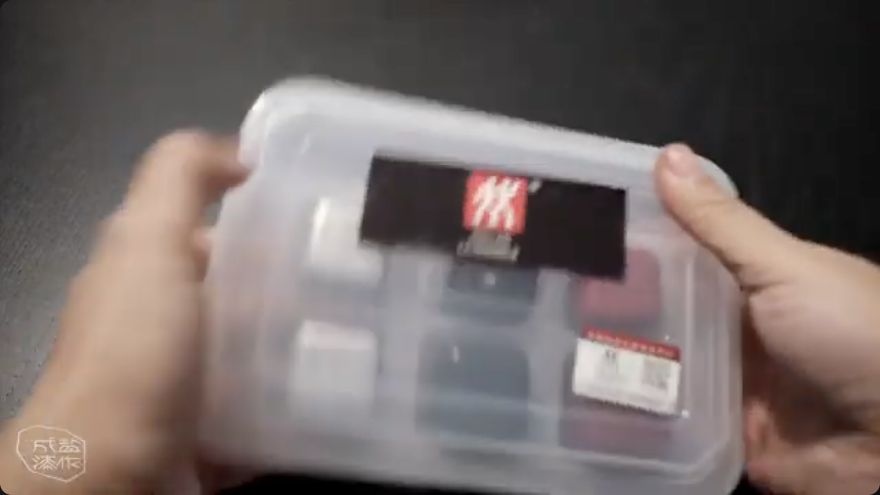
stainless steel ice cubes— Six cubes total; two bare, two sanded, two sandblasted
Conditions
cure time — 1 hour in oven for first coat; 1 week in hard-drying environment for final coats
notes — Hard-drying environment used for final curing
The method
Section by section.
Each heading links back to the moment in the source video where it begins.
One video is one workshop's account, not a complete method. 4 of 5 steps here are not fully settled by
this source — it leaves out what a correct result looks like, or how the step
fails. Those are marked in place below.
Divide six stainless steel ice cubes into three groups of two. Leave one group in its original state. Sand the second group with 320-grit abrasive paper. Sandblast the third group. These two preparation methods create different surface textures to test how adhesion affects insulating performance.
When it is rightSurfaces are uniformly textured according to the chosen method.
Not settled by this video The source does not show what going wrong looks like here.
Apply the first coat of ki-urushi to the prepared cubes. Place them in an oven for one hour to cure. This step is specifically intended to increase adhesion of the lacquer to the metal surface. After removing from the oven, lightly sand the surface to prepare for subsequent coats.
When it is rightThe first coat is firmly bonded to the metal substrate.
Not settled by this video The source does not show what going wrong looks like here.
Apply two additional coats of lacquer to all prepared cubes. For the cubes sanded with abrasive paper, apply kuro-urushi. For the cubes that were sandblasted, apply shu-urushi. The different colors allow for easy visual distinction during testing. After application, place the cubes in a hard-drying environment for one week to allow complete drying.
When it is rightA smooth, colored lacquer finish covers the metal surface.
Not settled by this video The source does not show what going wrong looks like here.
Store the dried cubes in a box and freeze them in a refrigerator overnight. The next day, prepare glass cups of identical size. Pour 30 grams of whiskey into each cup. Verify the initial temperature of the whiskey, which should be around 17.1 to 17.2 degrees Celsius, close to room temperature.
When it is rightWhiskey in all cups starts at a consistent baseline temperature.
Not settled by this video The source does not show what going wrong looks like here.
Place one ice cube in each cup. Take temperature measurements at three-minute, ten-minute, and thirty-minute intervals. Before inserting the thermometer into each cup, return it to room temperature to minimize error. Record the temperature of the whiskey in each cup at each interval to compare the insulating performance of the bare metal versus the lacquered cubes.
When it is rightTemperature data is recorded for all three cube types at each time point.
When it goes wrongSequential measurement with a single thermometer introduces timing errors of about 30 seconds per cup.
Terminology in this video
大漆daqi
Chinese raw natural lacquer
生漆ki-urushi
Raw unrefined lacquer
黒漆kuro-urushi
Black lacquer
朱漆shu-urushi
Vermilion lacquer
Left open
What this video does not settle.
The exact type of lacquer used for the two additional coats after the first ki-urushi coat is not specified
The specific conditions of the 'hard-drying environment' are not detailed
The thickness difference between the red and black lacquer layers is mentioned but not quantified