Kintsugi: Repairing an Antique Imari Plate with a Platinum Marufun Finish | Kintsugi Journal #4
This video demonstrates the multi-stage repair of a chipped foot ring on an antique Imari plate, finished with platinum powder. It is useful for advanced lacquer workers seeking a detailed walkthrough of kintsugi-style filling, sealing, and metal-powder finishing on ceramic.
A walkthrough written from chimahaga’s video ↗.
The recording is the authoritative demonstration; this page is a working guide to it.
Raw urushi (ki-urushi) and mugi-urushi cause serious delayed skin reactions; avoid skin contact and wear gloves.
Read Safety First before working with raw urushi.
Tools shown
masking tape— Used to protect surrounding glaze from lacquer stains.
hera— Spatula for mixing and applying filler.
cutter blade— Used to trim excess filler and test smoothness.
film sandpaper— 1500 and 2000 grit for flattening and polishing.
cloth— Used for applying kikumo and buffing.
Materials
mugi-urushi— Used for surface sealing (soshigatame) and final powder fixing (fun-katame).
tonoko— Polishing clay powder mixed with water and lacquer to create filler.
ki-urushi— Raw lacquer mixed with tonoko and cotton for the filler paste.
kokuso— Wood dust/cotton fiber added to the tonoko-lacquer mix.
kuro-urushi— Black lacquer (MR Takagyo) used for middle coats.
shi-urushi— White lacquer used as a neutral base for platinum powder.
suki-urushi— Transparent lacquer mixed with shi-urushi to adjust viscosity.
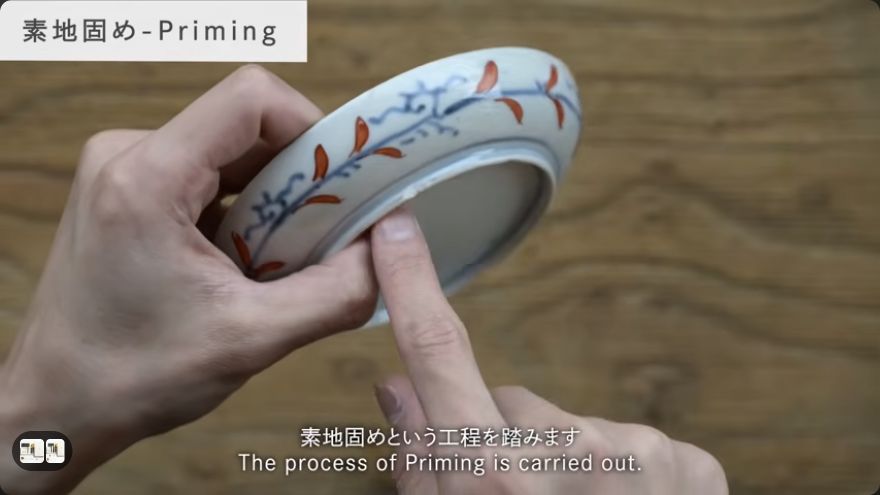
Mask the area around the chip with tape to protect the glaze, ensuring the tape does not cover any thin glaze losses. Apply mugi-urushi directly from the tube to the exposed cross-section. Press the surface lightly 2-3 times to thin the coat and ensure adhesion. Allow to cure in the furo for 2-3 days until hard and non-tacky.
When it is rightThe lacquer is hard, does not stick to the finger, and feels solid under the nail.
When it goes wrongIf the lacquer remains tacky, it has not cured; extend the furo time.
Mix tonoko with water to a paste, then add an equal amount of ki-urushi. Mix until smooth. Add a small amount of kokuso fiber until the surface shows slight texture but is not fluffy. Rub the paste into the chip, then build up a mound slightly above the surface level to account for shrinkage. Use a hera to shape it smoothly. Cure in the furo for 2-3 days.
When it is rightThe filler is solid and slightly proud of the surface, with a smooth texture.
When it goes wrongIf the filler is too fluffy, it becomes brittle; remake the mix with less fiber.
Remove the tape. Use a cutter blade held flat to shave off excess filler. Work in thin passes to avoid cutting into the substrate. The goal is for the blade to slide over the surface without catching. Check by touch with eyes closed; the repair should be indistinguishable from the surrounding surface.
When it is rightThe surface is flush and smooth; the cutter blade slides without resistance.
When it goes wrongIf the blade catches, there is still excess filler; continue trimming. If the surface is concave, reapply filler.
Mask the surrounding area again. Apply mugi-urushi directly from the tube to the filler. Wait 5 minutes; if it dries, apply more. After 10 minutes, wipe off excess with a tissue until no color transfers. This seals the porous filler. Cure in the furo.
When it is rightThe surface is sealed and smooth, with no sticky residue.
When it goes wrongIf the lacquer stains the surrounding glaze, it was not masked properly.
Apply a thin coat of kuro-urushi over the sealed filler. Avoid running onto the glaze. If the coat is too thick, thin it slightly. Cure in the furo. After curing, sand with 1500 grit film sandpaper to flatten, then 2000 grit to smooth. Repeat the coat and sanding process until the surface is uniform and the underlying filler is no longer visible.
When it is rightThe surface is uniformly black and smooth, with no visible filler layer.
When it goes wrongIf the filler layer is visible, apply another coat of kuro-urushi and sand again.
Mix shi-urushi with a small amount of suki-urushi to reduce viscosity. Apply a thin, even coat over the black lacquer. This neutral base prevents the red of ben-gara from showing through the platinum. Cure in the furo.
When it is rightThe surface is a uniform beige tone, ready for powder application.
When it goes wrongIf the coat is too thick, it may run; thin with suki-urushi.
Sprinkle 3-gou platinum marufun over the shi-urushi. Apply multiple layers, ensuring the edges are well-covered. The powder will appear gray initially but will polish to a silver sheen. Cure in the furo.
When it is rightThe powder is evenly distributed and adheres to the lacquer.
When it goes wrongIf the powder is uneven, apply more layers before curing.
Apply a thin coat of high-quality mugi-urushi over the platinum powder. Wipe off excess with a tissue until no color transfers. Cure in the furo for over a week. Sand with 1500 then 2000 grit film sandpaper. Finally, apply kikumo to a cloth and buff the surface to a high gloss.
When it is rightThe surface is a bright, durable silver with a high gloss and no scratches.
When it goes wrongIf the surface is dull, continue buffing with kikumo.
Terminology in this video
刻苧漆kokuso-urushi
Filler made from tonoko, lacquer, and wood fiber.
拭き漆fuki-urushi
Wipe-on lacquer technique for sealing and fixing.
丸粉marufun
Round metal powder for kintsugi finishing.
Left open
What this video does not settle.
The exact brand or grade of the 'high-quality' mugi-urushi used for powder fixing is not specified.
The specific type of kikumo polishing compound is not named.