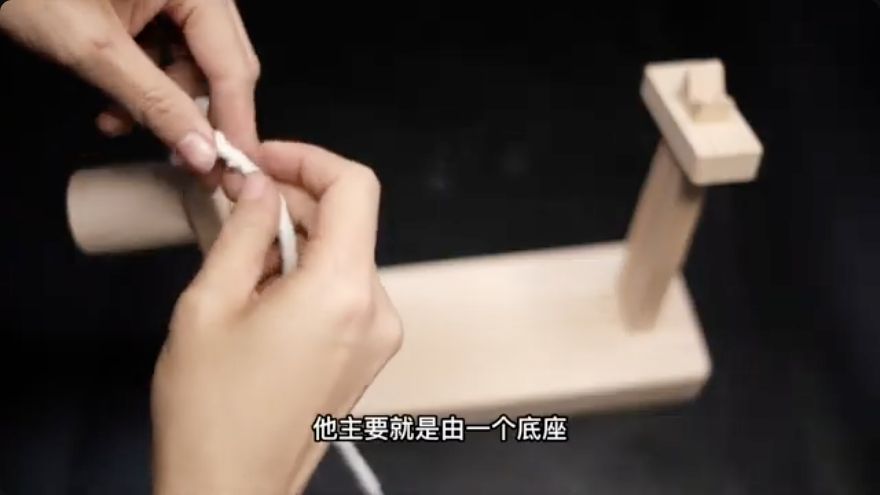
This video demonstrates the use of a Japanese-style lacquer filter press to remove impurities from colored lacquer. It is useful for lacquer artisans who need to prepare clean lacquer for final coats or decoration, showing the specific mechanics of the tool and the preparation of the filtered product for storage.
A walkthrough written from 成盐漆作 Lacquer ChengYan’s video ↗.
The recording is the authoritative demonstration; this page is a working guide to it.
Raw urushi causes serious delayed skin reactions; ensure proper ventilation and avoid skin contact with the lacquer and turpentine.
Read Safety First before working with raw urushi.
Tools shown
lacquer filter press— 1:1 replica of Japanese design; base, clamping strips, hemp rope, wooden knob
glass plate— For mixing lacquer and turpentine
spatula (hera)— For mixing and scraping excess lacquer
small bowl— Collection vessel for filtered lacquer
Materials
lacquer— Purple sugar color (likely a specific pigment mix), tube format
turpentine— Used for cleaning glass and diluting lacquer
mint oil— Two drops used to coat the inside of the collection bowl
filter paper— Japanese lacquer-specific paper, lint-free
cling film— Plastic wrap for sealing the bowl
Conditions
notes — Allow airborne dust to settle before filtering to prevent contamination.
The method
Section by section.
Each heading links back to the moment in the source video where it begins.
The press consists of a base with two ends: one for clamping filter paper and one for a hemp rope knob. Pass the sieve through the designated hole, insert the hemp rope, and tie a knot. The other end secures the opposite side of the filter paper. Ensure the workspace is clean and allow airborne dust to settle before beginning to prevent contamination.
When it is rightThe rope is securely knotted and the clamping mechanism is ready to hold the paper taut.
When it goes wrongIf the rope slips, the pressure will not be uniform, leading to incomplete filtration.
Wipe a glass plate clean with turpentine. Squeeze the lacquer onto the plate and add a small amount of turpentine to dilute it slightly; mix well. In a small collection bowl, drop two drops of mint oil and wipe it evenly over the bottom and sides with tissue paper. This coating prevents lacquer from sticking to the rim, making cleanup easier.
When it is rightThe lacquer is uniformly mixed and the bowl interior is coated with a thin film of oil.
When it goes wrongIf the bowl is not oiled, lacquer will adhere to the rim, making it difficult to scrape off cleanly.
First, position the lint-free Japanese filter paper within the prepared bowl. Next, transfer the mixed lacquer onto the paper's interior surface. Enclose the lacquer by twisting the paper in a manner similar to wrapping a candy. Then, guide one end of this twisted assembly into the gap formed by the two wooden strips located on the left side of the press. Finally, secure the top using a square wooden block to stop the paper from sliding out.
When it is rightThe lacquer is fully enclosed within the paper, and the paper is securely clamped on one side.
When it goes wrongIf the paper is not twisted tightly, lacquer may leak around the edges during pressing.
Tie the free end of the filter paper to the hemp rope on the right side of the press. Twist the wooden knob on the right to apply tension. As the rope tightens, the lacquer is squeezed out of the paper and drips into the bowl below. Continue twisting until the flow slows, then use a clean spatula to scrape off any excess lacquer remaining on the surface of the filter paper.
When it is rightThe extracted lacquer is clean and free of visible impurities. The paper is fully drained.
When it goes wrongIf the pressure is too high, the paper may tear, allowing impurities to pass through.
Wipe any lacquer stuck to the rim of the bowl with tissue paper. Cut a piece of cling film slightly larger than the bowl. Fold it to size, then unfold it into a circular shape. Place the center of the film over the lacquer, then press down the edges. Fold the excess film back inward to seal the bowl. Attach a label indicating the color and the date of filtering.
When it is rightThe bowl is fully sealed with no air gaps, and the label is clearly visible.
When it goes wrongIf the film is not cling type, the lacquer may dry faster due to increased air exposure.
Terminology in this video
箆hera
spatula used for mixing and scraping lacquer
上塗uwa-nuri
final coat of lacquer
Left open
What this video does not settle.
The specific type of 'purple sugar color' lacquer is not identified beyond the ASR term.
The exact quantity of turpentine added for dilution is not specified.