This video evaluates the color stability and visual texture of 18 domestic metal powders (copper, silver, imitation gold) when combined with lacquer. It is useful for lacquer artists selecting powders for specific finishes, such as nashiji-like textures or metallic grounds, and demonstrates the necessary fixing and polishing steps to achieve stable results.
A walkthrough written from 成盐漆作 Lacquer ChengYan’s video ↗.
The recording is the authoritative demonstration; this page is a working guide to it.
Raw urushi (ki-urushi) causes serious delayed skin reactions; handle with care and avoid direct skin contact.
Read Safety First before working with raw urushi.
Tools shown
Microscope— Used at 500x and 1000x magnification to inspect powder particles
600 mesh sandpaper— Used for final polishing
Technique board— Divided into four sections for categorization
Materials
Domestic copper powder— Complete and strip-shaped varieties; various mesh sizes
Domestic pure silver powder— Very fine, approx. 2000 mesh
Imitation gold powder— Recommended for tamenuri or xipi lacquer
Pearl-red lacquer— Base coat for most powders
Transparent lacquer— Base for gold/silver; used for fixing coarse powders
Diluted ki-urushi— Used to fix fine powders (300 mesh or finer)
Conditions
notes — Powder color stability varies; pure gold is most stable, while copper and silver may change color over time.
The method
Section by section.
Each heading links back to the moment in the source video where it begins.
Divide the technique board into four sections based on powder type (marufun-style vs. coarse/medium/fine). Apply a base coat of pearl-red lacquer to most sections. For pure gold and pure silver powders, use a base-color transparent lacquer instead. Ensure the surface is flat; for silver, the transparent lacquer layer must be extremely thin or merely wiped on to avoid amplifying surface unevenness after sprinkling.
When it is rightA smooth, uniform base coat ready for powder application.
When it goes wrongIf the base coat is too thick or uneven, the final powder surface will appear irregular and textured.
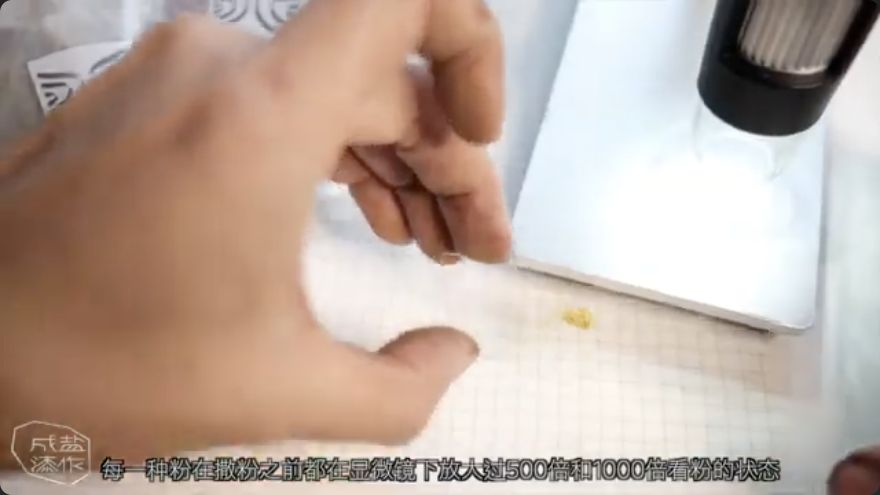
Before application, observe each powder under a microscope at 500x and 1000x magnification to assess particle shape and size. Sprinkle the selected metal powder onto the prepared lacquer base. Note that copper powders come in complete and strip-shaped forms, which yield different particle feels and final textures. Imitation gold powder is noted for its realistic gold texture.
When it is rightEven distribution of powder particles on the tacky lacquer surface.
When it goes wrongClumping or uneven distribution if the powder is not sprinkled evenly.
Fix the sprinkled powder using lacquer. For fine powders (300 mesh or finer), apply a single coat of diluted ki-urushi. For powders with obvious coarse particles, apply two coats: the first with diluted ki-urushi, and the second with transparent lacquer. This two-step process ensures coarse particles are securely embedded without shifting.
When it is rightPowder is firmly adhered to the surface without displacement.
When it goes wrongPowder may shift or fall off if not fixed with sufficient lacquer coats, especially for coarse particles.
Polish the fixed powder surface using 600 mesh sandpaper. The resulting texture varies by powder: copper bowl powder creates a starry, circular nashiji-like effect resembling shark skin; pure silver powder yields a fine silver foil texture; fine copper powders produce a matte, bone-like metallic effect. Imitation gold powder is suitable for tamenuri or xipi lacquer decorations but not for jinshan.
When it is rightA smooth, polished surface with the desired metallic texture and color stability.
When it goes wrongOver-polishing may remove powder or create uneven surfaces; under-polishing leaves a rough texture.
Terminology in this video
丸粉marufun
Coarser round gold powder
梨子地nashiji
Pear-skin sprinkled ground
溜塗tamenuri
Transparent lacquer over a coloured ground
生漆ki-urushi
Raw unrefined lacquer
Left open
What this video does not settle.
Exact mesh sizes for all 18 powder types are not specified.
Specific drying times between fixing coats are not mentioned.
The exact composition of 'imitation gold powder' is not detailed.